What Does Collision Insurance Cover After a Car Accident in New Mexico?
Getting into a car accident is stressful enough without trying to decode your insurance policy in the aftermath. If you have collision coverage on your New Mexico auto insurance policy, you're in a much better position than you might realize — but understanding exactly how it works, step by step, can make the claims process far less overwhelming. This post breaks down everything you need to know about collision insurance after an accident in New Mexico, from filing your claim to what happens if your car is declared a total loss.
What Collision Insurance Actually Covers (and What It Doesn't)
Collision insurance covers the cost to repair or replace your vehicle after it's been damaged in a collision — regardless of who caused the accident. That last part is important. Whether you rear-ended someone, got sideswiped, or slid off the road on an icy New Mexico highway, collision coverage pays for your car's damage.
Here's what collision insurance typically covers:
- Damage to your vehicle from hitting another car
- Damage from hitting a stationary object (a guardrail, fence, or utility pole)
- Rollover accidents
- Single-vehicle crashes, such as sliding off the road
What collision insurance does not cover:
- Damage to the other driver's vehicle — that's handled by your liability coverage
- Medical bills for you or your passengers — that falls under medical payments or personal injury protection coverage
- Theft, weather damage, or hitting an animal — those are covered by comprehensive insurance
- Your deductible amount — you always pay that portion yourself
It's also worth knowing that New Mexico does not legally require drivers to carry collision insurance. However, if you financed or leased your vehicle, your lender almost certainly requires it as a condition of your loan. Once your vehicle is paid off, carrying collision coverage becomes your choice — though it's often still worth it depending on your car's value.
Step-by-Step: How to File a Collision Claim in New Mexico
If you've been in an accident, here's what the claims process looks like from start to finish:
- Make sure everyone is safe and call 911 if needed. In New Mexico, you're required to report accidents that result in injury, death, or significant property damage.
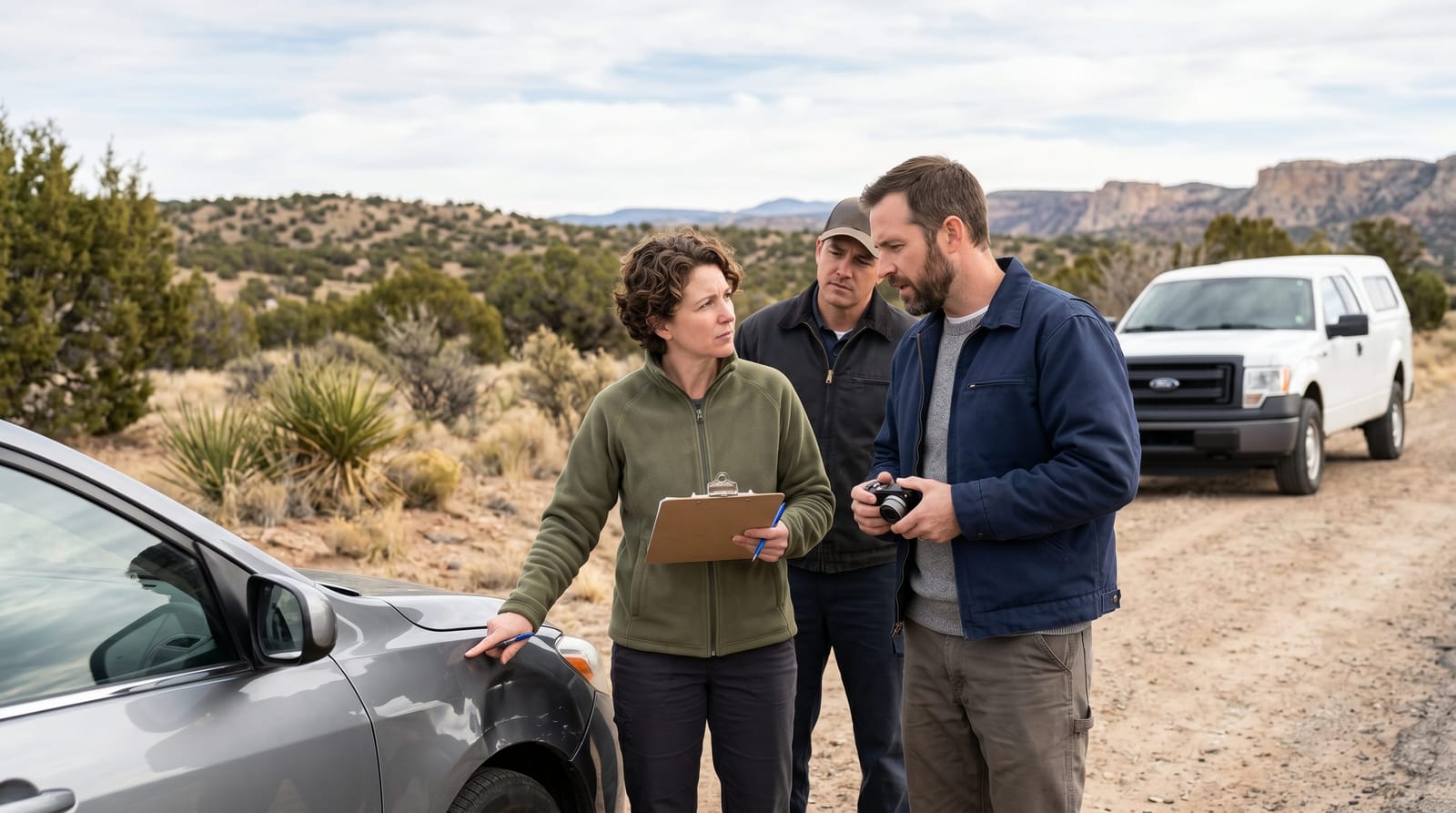
- Document the scene. Take photos of all vehicles involved, the surrounding area, road conditions, and any visible damage. Get the other driver's name, contact information, license plate, and insurance details.
- Notify your insurance company promptly. Most insurers require you to report accidents quickly — some policies specify within 24 to 72 hours. Call your agent or use your insurer's app or online portal to open a claim.
- A claims adjuster is assigned to your case. This person will review the circumstances of the accident, assess fault where relevant, and coordinate the damage evaluation.
- Your vehicle is inspected. The adjuster (or an approved inspector) will examine your car either at a repair shop or at an inspection facility. They'll create a repair estimate based on the damage.
- Repairs are authorized and completed. Once the estimate is approved, you can take your car to an authorized repair shop. Many insurers have preferred shops, but you typically have the right to choose your own.
- You pay your deductible. When you pick up your repaired vehicle, you'll pay your deductible directly to the repair shop. Your insurer covers the rest of the approved repair cost.
Understanding Your Deductible and How It Affects Your Payout
Your collision deductible is the amount you agree to pay out of pocket before your insurance kicks in. Common deductible amounts are $250, $500, $1,000, or higher. The higher your deductible, the lower your monthly premium — but the more you'll owe after an accident.
Here's a simple example: Your car sustains $4,200 in damage after a collision. You have a $500 deductible. Your insurer pays $3,700, and you pay $500 to the repair shop when you pick up the car.
One important consideration — if the at-fault driver in your accident is uninsured or underinsured, you'd still use your collision coverage to get your car repaired. You'd pay your deductible upfront, but your insurer may pursue the at-fault driver to recover those costs (a process called subrogation). If they successfully recover the money, you may get your deductible refunded.
Rental Car Coverage During Repairs
Being without your car while it's in the shop is a real inconvenience, especially in New Mexico cities and rural areas where driving is essential. Rental car reimbursement coverage, if you added it to your policy, pays for a rental vehicle while yours is being repaired.
This is usually expressed as a daily limit and a total maximum — for example, $35 per day up to $1,050. That may not cover a luxury rental, but it keeps you mobile during the repair period. If your repairs are expected to take a week or more (which is common for significant collision damage), rental coverage becomes extremely valuable.
If you didn't add rental reimbursement to your policy, you'll be paying out of pocket for a rental — unless the other driver was at fault, in which case their liability insurance should cover your rental costs.
Speaking of coverage gaps, if you frequently drive outside urban areas, it's worth understanding how your policy handles different road conditions and situations — auto insurance rural New Mexico coverage explains what to consider when you're spending time on less-traveled roads.
When Your Car Is Declared a Total Loss
Sometimes the cost to repair your vehicle exceeds its actual cash value (ACV) — and in those cases, your insurer will declare the car a total loss. In New Mexico, this typically happens when the repair estimate reaches or exceeds a certain percentage of the car's market value (often 75–80%, though this varies by insurer).
Here's what happens next:
- Your insurer will determine the ACV of your vehicle based on its make, model, year, mileage, condition, and local market data at the time of the accident.
- You'll receive a settlement offer for that amount, minus your deductible.
- You'll sign over the vehicle title to the insurer, who then typically sells it to a salvage yard.
- If you still owe money on your car loan, your settlement goes first to the lender. If the ACV is less than what you owe, you're responsible for the difference — which is exactly why GAP insurance exists.
If you disagree with the insurer's valuation of your totaled vehicle, you have the right to negotiate. Gather comparable vehicle listings in your area, document any recent upgrades or repairs, and present that evidence to your adjuster. You can also request an independent appraisal.
Frequently Asked Questions
Is collision insurance required in New Mexico?
No. New Mexico does not legally require collision insurance. However, if you have a car loan or lease, your lender will almost always require you to carry collision coverage to protect their investment in the vehicle.
What if the other driver was at fault — do I still use my collision coverage?
You have a choice. You can file a claim with the at-fault driver's liability insurance — but that process can take longer. Filing through your own collision coverage is typically faster, and your insurer will then pursue reimbursement from the at-fault driver's insurer on your behalf.
Does collision insurance cover hit-and-run accidents in New Mexico?
Yes. If you're the victim of a hit-and-run and the other driver can't be identified, your collision coverage will pay for repairs to your vehicle, minus your deductible. This is one of the most practical reasons to carry collision coverage even on an older vehicle.
How does a collision claim affect my insurance rates?
Filing a collision claim — especially if you were at fault — can result in a rate increase at your next policy renewal. The amount varies by insurer and your driving history. If you have accident forgiveness as part of your policy, your first at-fault accident may not trigger a rate increase.
The Bottom Line on Collision Insurance After a New Mexico Accident
Collision insurance is one of the most practical protections you can have as a New Mexico driver. It covers your vehicle regardless of fault, keeps the repair process moving, and protects you from major out-of-pocket costs after an accident. Understanding your deductible, knowing when to expect a rental car, and being prepared for the total loss process makes navigating a claim far less stressful. For a full picture of how collision fits into your overall auto policy, the complete guide to auto insurance in New Mexico covers everything from required coverages to finding the best value for your situation.